
Project Overview
Digitalpedi built a website for Romax Guard in Büyükçekmece, which applies Solar Gard film to architectural and residential glass only. The site has a catalog of 21 Solar Gard films (17 with their own product pages and 4 commercial-building films summarized on one page), 13 guide posts, a home page that draws the time of day as you scroll, and a film selection assistant.
Romax Guard is the architectural and residential window film brand of Romax Otomotiv. Romax Otomotiv’s Solar Gard Premium Büyükçekmece site is a separate project and is part of the network described in the Solar Gard Türkiye client work.
A catalog that publishes no unsourced numbers
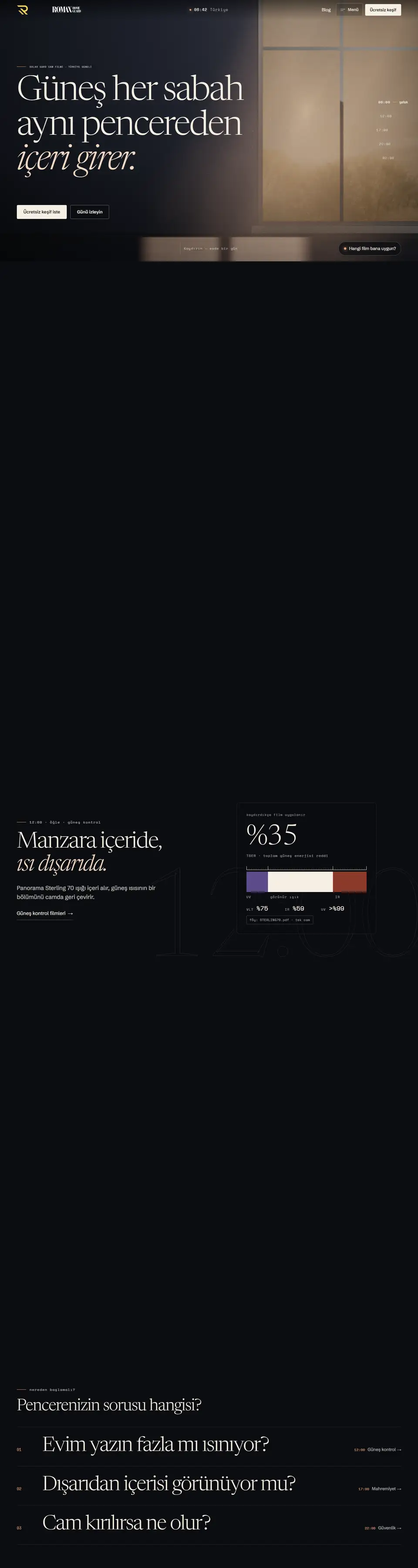
Choosing window film comes down to numbers: visible light transmission, solar energy rejection, UV blocking. Romax Guard publishes these numbers with their sources; next to the tables and charts on product pages sits the file name of the Solar Gard datasheet or Solar Gard’s global technical data. The note “datasheet: STERLING70.pdf · single pane” for Panorama Sterling 70 is one example.
We did not leave the rule to the author’s attention; we tied it to the build. The source field is mandatory in the content schema, and a check that runs before the build catches any number without a source. A value whose datasheet has not been confirmed is not filled in with an estimate; the site marks it with a “technical datasheet in preparation” plate.
A day at home: the hour changes as you scroll
The scene on the Romax Guard home page is drawn by code, not photographs: a WebGL2 shader with no library renders a fixed room in the background, and scrolling advances the time in that room. The hours come in order: 06:00 dawn, 12:00 noon, 17:00 evening, 22:00 night and 02:00 winter night.
Each hour is tied to a window film topic: solar control at noon, privacy in the evening, security at night, heat insulation on a winter night. If WebGL is not supported, a reduced-motion preference is on, or JavaScript is off, the page still shows its content through a CSS-based fallback view.
Film selection assistant
The “Which film is right for me?” assistant on the Romax Guard site starts by asking about the space: apartment, detached house or villa, office or workplace, school or public building. On most paths it then asks what bothers the visitor most and what type of glass they have; if a school or public building is chosen, the assistant goes straight to the corporate building films result. At the end it shows the suitable film family, product suggestions on most paths, a pre-filled WhatsApp message and the phone number.
The assistant is a static decision tree: it is not connected to a server or an AI service, so its running cost is zero. The recommendation is not treated as a final decision; the assistant’s own note says it is confirmed once the glass is seen on site.
The client’s own publishing panel
The client’s staff publish the Romax Guard blog posts from an admin panel. The panel is built on Sveltia CMS and works with a GitHub App, a Cloudflare Worker and Cloudflare Access login.
Before a post goes live, it passes through a pipeline on GitHub Actions: validation, quarantine, publishing and live steps. When it is published, a notification lands on Telegram. The blog currently has 13 posts live, on solar control, commercial buildings, heat insulation, privacy and security.
Infrastructure for search engines and AI
The Romax Guard site has page-level structured data: Product on product pages, FAQPage on the FAQ page and BlogPosting on blog posts. A sitemap, an RSS feed and an llms.txt file listing short answers from the products, FAQ and guide posts are also live.
Verification
The numbers on this page were counted from the live site on September 30, 2026: the romaxguard.com sitemap has 53 addresses, the home page film cards show 21 films in total, the blog page has 13 posts, and the service regions page has 7 regions. The site footer shows the “Yazılım: Digitalpedi” link, which goes to digitalpedi.com.